 Betty Ford Alpine GardensBetty Ford Alpine Gardens


From tiny pikas hiding among alpine rocks to mountain goats navigating steep cliffs, the Rocky Mountains are home to remarkable mammals adapted to life at high elevations.
This introductory guide focuses on 10 mammals native to the Rocky Mountain region, emphasizing alpine and subalpine habitats. Each entry includes a photo reference, identifying features, and clues for recognizing tracks.
(Ochotona princeps)
Habitat: Alpine rock fields
Description: A tiny, round-eared relative of rabbits that lives among rocky slopes. Listen for its sharp, squeaky call.
Tracks: Small, furry-footed prints, often in hopping groups. Hind feet land ahead of front feet.
(Marmota flaviventris)
Habitat: Alpine meadows and rocky slopes
Description: A large, stocky ground squirrel with brown fur and a yellowish belly. Often seen sunning itself on rocks.
Tracks: Five toes on hind feet, four on front feet; long claw marks may be visible.
(Oreamnos americanus)
Habitat: High alpine cliffs
Description: A shaggy white mammal with short black horns and specialized hooves for climbing. Native to parts of the northern Rockies; introduced in Colorado.
Tracks: Two rounded, spreading hoof impressions, often with a broad, blocky appearance.
(Ovis canadensis)
Habitat: Alpine cliffs and open slopes
Description: Powerful mountain climbers. Males have massive curled horns; females have smaller, slender horns.
Tracks: Split hooves, generally narrower and more pointed than mountain goat prints.
(Cervus canadensis)
Habitat: Montane and subalpine meadows
Description: A large deer with a tan body and pale rump. Bulls grow impressive branching antlers.
Tracks: Large, elongated split-hoof prints with pointed tips.
(Alces alces)
Habitat: Willow wetlands and subalpine forests
Description: The largest member of the deer family, with long legs, a prominent muzzle, and broad antlers on mature bulls.
Tracks: Very large, elongated split hooves, often spread apart in soft ground.
(Lepus americanus)
Habitat: Subalpine forests
Description: A hare with large, furry hind feet that help it travel across snow. Its coat changes from brown to mostly white in winter.
Tracks: Two large hind-foot prints ahead of two smaller front-foot prints.
(Vulpes vulpes)
Habitat: Mountain forests and meadows
Description: A slender canine with pointed ears, a bushy tail, and often reddish fur.
Tracks: Four-toed oval paw prints with claw marks, commonly arranged in a straight travel line.
(Canis latrans)
Habitat: Mountain meadows and open forests
Description: A highly adaptable canine with gray-brown fur, upright ears, and a narrow muzzle.
Tracks: Four toes, a triangular heel pad, and usually visible claw marks.
(Ursus americanus)
Habitat: Montane and subalpine forests
Description: A powerful omnivore whose coat may be black, brown, or cinnamon-colored.
Tracks: Five toes with a broad heel pad and claw marks; hind prints can resemble a human footprint.
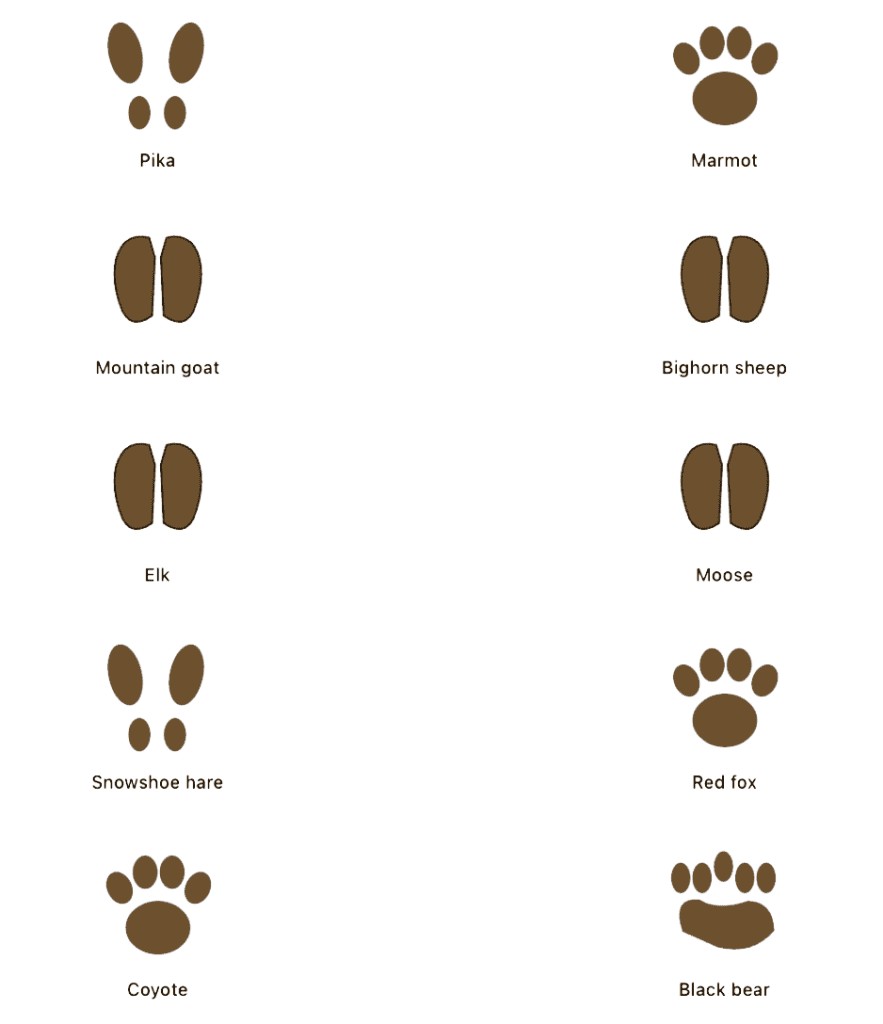
Tracks vary with snow depth, mud, speed, and ground conditions. Never identify an animal from a single unclear print. Protect the wildlife you discover. Observe animals from a safe distance, never feed them, and avoid disturbing sensitive alpine habitats.
Note: These simplified track-pattern sketches, show overall shape rather than provide exact-scale scientific illustrations. These are conceptual silhouettes only.
At 8,200 feet in Vail, Colorado, Betty Ford Alpine Gardens offers an opportunity to discover mountain plants and learn about the importance of protecting alpine ecosystems.
The Gardens are free to visit, and the outdoor gardens are open daily from dawn to dusk.
Editorial note: This is an introductory regional guide, not a verified inventory of mammals observed at Betty Ford Alpine Gardens. Some examples occur in foothill or subalpine habitats rather than exclusively above treeline.