 Betty Ford Alpine GardensBetty Ford Alpine Gardens


High in the Rocky Mountains, even the smallest insects play an important role in keeping alpine ecosystems alive. From fuzzy bumble bees to delicate butterflies, these pollinators help wildflowers reproduce and support the biodiversity of mountain meadows.
This beginner-friendly guide highlights 13 groups of pollinating insects found in the Rocky Mountain region, with special attention to subalpine and alpine habitats.
Bees are among the most important pollinators of Rocky Mountain wildflowers. Many native species can forage in the cool, unpredictable conditions of mountain environments.
(Bombus balteatus)
Identify: Large, fuzzy bee with black and yellow bands; the precise pattern varies.
Where: High-elevation meadows, tundra, and mountain wildflowers.
Look for: A furry bee visiting alpine flowers even in cool weather.
(Bombus sylvicola)
Identify: Small to medium-sized bumble bee with yellow and black coloring, often with orange or reddish abdominal hairs.
Where: Mountain meadows, forest openings, and alpine habitats.
Look for: A compact, fuzzy bee moving between low-growing wildflowers.
(Osmia species)
Identify: Small, sturdy bees, sometimes metallic blue or green; many carry pollen on hairs beneath the abdomen.
Where: Rocky Mountain woodlands, foothills, and some high-elevation habitats.
Look for: A small bee gathering pollen beneath its body.
(Andrena species)
Identify: Small to medium-sized bees, often brown, black, or golden-haired.
Where: Open mountain slopes, meadows, and patches of exposed soil.
Look for: Bees visiting spring and summer flowers; females often nest in the ground.
Butterflies are among the easiest pollinators to recognize. Some Rocky Mountain species are particularly well adapted to cold, high-elevation environments.
(Parnassius smintheus)
Identify: White to translucent wings with dark markings and red spots on the hindwings.
Where: Rocky Mountain alpine and subalpine meadows.
Look for: A pale butterfly fluttering close to the ground among wildflowers.
(Colias meadii)
Identify: Orange-yellow wings with darker borders, particularly noticeable in males.
Where: High alpine meadows and tundra in the Rocky Mountains.
Look for: A small, bright butterfly flying low over alpine vegetation.
Not all moths are active at night. Some mountain moths visit flowers during daylight and can be mistaken for hummingbirds or bees.
(Hyles lineata)
Identify: Large, streamlined moth with pale stripes on the forewings and pink-and-black hindwings.
Where: Rocky Mountain foothills, valleys, and mountain meadows; not restricted to alpine elevations.
Look for: A fast-flying moth hovering in front of flowers while drinking nectar with a long proboscis.
Flies are especially important in cold mountain habitats, where they may remain active when other pollinators are scarce.
(family Syrphidae)
Identify: Often yellow and black like bees or wasps, but with very large eyes, short antennae, and only one pair of wings.
Where: Mountain meadows, forest edges, and alpine wildflower communities.
Look for: An insect hovering almost motionless before landing on a flower.
(family Bombyliidae)
Identify: Fuzzy, round-bodied flies with long, slender mouthparts; some resemble tiny bees.
Where: Sunny, open habitats throughout the Rocky Mountain region, including some mountain elevations.
Look for: A furry fly hovering while extending its long mouthparts into a flower.
Beetles are often overlooked as pollinators. Some visit flowers to feed on pollen, nectar, or other floral resources and transfer pollen as they move.
(subfamily Lepturinae)
Identify: Elongated bodies, hard wing covers, and often long antennae.
Where: Rocky Mountain forests, clearings, and flower-rich mountain meadows.
Look for: A slender beetle crawling across an open flower and feeding on pollen.
Hummingbirds are among the most remarkable pollinators of the Rocky Mountains. Although they are birds rather than insects, these tiny, fast-moving visitors play an important role in pollinating mountain wildflowers.
Several hummingbird species migrate through or breed in Colorado, visiting subalpine meadows and occasionally alpine tundra during the short summer growing season.
(Selasphorus platycercus)
Identify: Small green hummingbird with a white chest. Males have a brilliant rose-red throat and produce a distinctive metallic trilling sound with their wings.
Where: Colorado mountain forests, meadows, and subalpine habitats, commonly breeding at elevations up to about 10,500 feet and sometimes higher.
Look for: A hovering hummingbird feeding on tubular wildflowers, particularly red or pink blossoms.
Alpine connection: One of Colorado’s most characteristic high-elevation breeding hummingbirds.
(Selasphorus rufus)
Identify: Small hummingbird with rusty-orange coloring. Males have a vivid orange-red throat; females are mostly green above with rusty coloring on their sides and tail.
Where: Mountain meadows, forest edges, and high-elevation wildflower areas during migration through Colorado.
Look for: A fast, energetic hummingbird aggressively defending a patch of nectar-rich flowers.
Alpine connection: A seasonal migrant that uses Colorado’s mountain wildflowers as important feeding resources, especially during late summer.
(Selasphorus calliope)
Identify: North America’s smallest regularly breeding bird. Males have distinctive magenta throat streaks against a pale background.
Where: Mountain meadows, open forests, and shrubby slopes in western Colorado, particularly during migration.
Look for: A very small hummingbird feeding among flowering shrubs and mountain wildflowers.
Alpine connection: Occurs in Colorado’s mountain environments but is less characteristic of high alpine tundra than the broad-tailed hummingbird.
Hummingbirds use their long bills and extendable tongues to drink nectar from flowers. As they feed, pollen can collect on their heads and bills and transfer to the next flower they visit.
In Colorado’s mountain environments, hummingbirds may visit:
If you see… | It might be… |
| Large, fuzzy insect with yellow and black bands | Bumblebee |
| Small, metallic blue or green bee | Mason bee |
| Brown or golden-haired bee near bare soil | Mining bee |
| White butterfly with red spots | Rocky Mountain parnassian |
| Small orange-yellow butterfly above tundra | Mead’s sulphur |
| Fast-moving insect hovering like a hummingbird | Sphinx moth |
| Yellow-and-black fly hovering over flowers | Hoverfly |
| Fuzzy fly with a long, straight mouthpart | Beef ly |
| Hard-shelled insect crawling through flower pollen | Flower longhorn beetle |
| Rose-red throat, metallic wing trill | Broad-tailed hummingbird |
| Rusty-orange body, rapid territorial flight | Rufous hummingbird |
| Tiny size, magenta throat streaks | Calliope hummingbird |
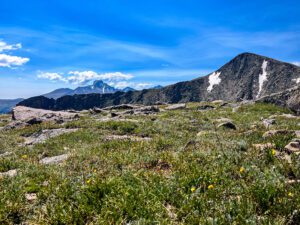 Alpine tundra
Above the treeline, look for bumble bees, parnassian butterflies, sulphur butterflies, and flower-visiting flies.
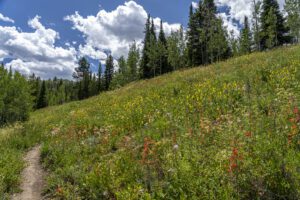 Subalpine meadows
Colorful summer wildflowers attract bees, butterflies, moths, flies, and beetles.
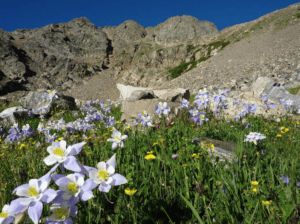 Rocky slopes and open ground
Watch for ground-nesting bees and small flower-visiting insects around sheltered patches.
Alpine plants often have a short growing season. Pollinating insects and birds help many flowering plants produce seeds during the brief mountain summer.
Pollinators also face challenges from changing temperatures, shifts in flowering times, and habitat disturbance. Protecting native plants and their habitats helps sustain the relationships between insects, birds and wildflowers.
At 8,200 feet in Vail, Colorado, Betty Ford Alpine Gardens offers an opportunity to discover mountain plants and learn about the importance of protecting alpine ecosystems.
The Gardens are free to visit, and the outdoor gardens are open daily from dawn to dusk.
Editorial note: This is an introductory regional guide, not a verified inventory of insects observed at Betty Ford Alpine Gardens. Some examples occur in foothill or subalpine habitats rather than exclusively above treeline. Species-level identification often requires close photographs or expert examination.